
dlc@developer:~$
<diego-leandro-cofre/>
software dev @ bue.ar
20+ years building enterprise software
Integrations · APIs · Electronic invoicing · Applied AI
software dev @ bue.ar
20+ years building enterprise software
Integrations · APIs · Electronic invoicing · Applied AI
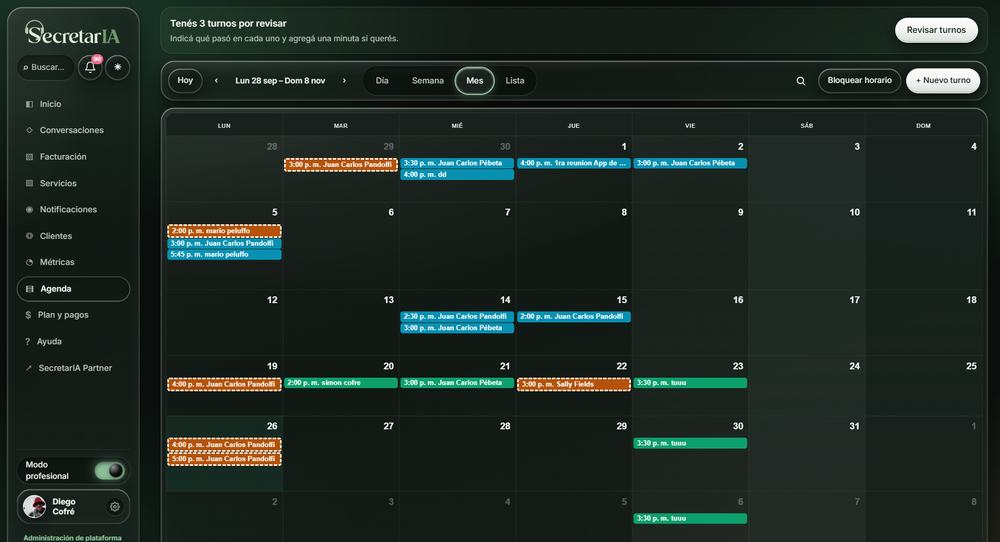
OWN PRODUCT · SAAS · APPLIED AI
An intelligent receptionist for professionals and small businesses.
Multi-tenant SaaS platform using AI to handle customers, answer questions and manage schedules and reservations automatically.
Stack: Conversational AI · Scheduling · Automation · SaaS
OPEN SOURCE · .NET 10 · MCP · FISCAL INTEGRATION
Argentine electronic invoicing for applications and AI agents.
Open-source .NET 10 project simplifying ARCA integrations through an MCP server and a reusable .NET library.
Stack: .NET 10 · MCP · ARCA · Electronic invoicing
C#/.NET 1–10, Python, FastAPI, ASP.NET MVC, PHP, JavaScript, React, Next.js, Celery, Bootstrap
SQL Server, PostgreSQL, MySQL, Oracle, DynamoDB, Redis
Docker, AWS, Git
REST/SOAP APIs, International e-invoicing, Fiscal integrations, Automation, Legacy modernization, Backend architecture, Applied AI

Custom software development for local and international clients, covering backend systems, APIs, microservices and automation.
Electronic invoicing for Argentina (AFIP/ARCA), Uruguay (DGI), Costa Rica (Ministry of Finance) and Spain (FACe / Facturae). REST APIs in .NET and Python, FastAPI and applied AI integrations.
Stack: .NET, C#, Python, FastAPI, PHP, SQL Server, PostgreSQL, MySQL, Docker, REST, OpenAI API

Uruguay · remote
Contributing to the modernization of Cuántico, LogiKom’s enterprise electronic invoicing platform.
Progressive evolution of .NET/SOAP/WCF services toward a layered architecture with a reusable business core, preserving compatibility and DGI/CFE/CAE fiscal integrations.
Stack: .NET, C#, WCF, SOAP, SQL Server, DGI, CFE, CAE

Mendoza, Argentina
Backend development and maintenance for the core platform, including payment gateway integrations, process optimization and ongoing support.
Stack: .NET 4.6, ASP.NET MVC, SQL Server, T-SQL, Git, Payment APIs

Buenos Aires, Argentina
Full web and backend development for a platform focused on professional photographers.
Stack: .NET, MVC, SQL Server, AWS, Git

Buenos Aires, Argentina
Custom websites and business systems, with long-term technical support for end clients.
Selected project: Asociación de Ejercicios Acuáticos (AEA) website.
Stack: PHP, Python, MySQL, SQL Server

Designed and developed the core framework for online products. Migrated legacy SOAP services to REST APIs with close to 10x performance improvements and built a REST quotation service with Swagger.
Stack: .NET Core, ASP.NET MVC, SQL Server, AWS, Git

Buenos Aires, Argentina
Analysis, design and development of SIR for Argentina’s Ministry of Modernization, plus work on TAD and Buenos Aires City payment systems.
Stack: .NET, SQL Server
Buenos Aires, Argentina
Development and maintenance of core products eWave.Manager, eBoc and eCom; created early versions of eCall, eBoc.ATM and eWave.Corporate.
Selected project: Cinema Adrogué online ticketing integrated with EcallWS.
Stack: .NET 1.1/2.0, WinForms, WebForms, SOAP, SQL Server, Visual Studio, SourceSafe

Buenos Aires, Argentina
Analysis and development of nationwide statistical systems: SAYCO (2001 Census), CVS, SIP and ENADIC/EANNA survey systems.
Stack: Visual Studio 5/6, ASP, .NET 1.0, SQL Server, Oracle

Universidad de Buenos Aires (1993–2000)

Cambridge University (1990)




Microsoft Users Group (2023)

LinkedIn Learning


Microsoft (2005)
I have been fascinated by the idea of giving intelligence to machines since I was a kid. At ten I got my hands on a TI 99/4A and, between lines of primitive BASIC, started programming my first experiments. I did not really know what I was doing yet, but I knew I wanted to understand how those machines worked. That curiosity never went away.
I began my professional career at INDEC in 1999, initially working on Windows systems for surveys and statistical processes and later contributing to the administration system for Argentina’s 2001 National Census. It was an intense formative period: real systems, sensitive data and country-scale impact. It taught me that software is not only code, but also commitment and responsibility. I still remember the words of my manager and mentor Susana Tielas: "You know how to program; I am going to teach you how to build systems."
Many years followed at different companies, mostly as a full-stack .NET developer from almost the beginning of the platform. I worked across several technology generations, from WinForms and WebForms to more modern service-oriented architectures. Along the way I added tools and languages —PHP, Python, Node.js and current frameworks— not because they were fashionable, but because the problems and my curiosity called for them. I have always cared about choosing the right tool for each problem.
Over time I specialized in complex integrations, process automation, robust API development and, in particular, electronic invoicing and fiscal compliance systems for multiple countries. In recent years I have also been exploring the integration of generative AI into real systems, focusing beyond the hype on concrete, useful and measurable applications.
After years of salaried employment, in 2024 I finally took a step I had been considering for a long time and moved into independent work. It brought both uncertainty and freedom, but also a return to something essential: taking end-to-end responsibility for what I build, choosing projects, speaking directly with clients and users, and applying technical judgment to real problems.
ARCA-MCP was born from that same spirit: an open-source project I developed to simplify integration with ARCA electronic invoicing services. What started as a .NET library evolved into a broader integration architecture, with a reusable core and an authenticated MCP server that securely connects applications, automations and agents with real fiscal services. Maintaining projects like this is also a way for me to give back some of what I have learned along the way.
Beyond technology, I am still driven by the same curiosity: understanding how we think and what happens when we try to put some of that intelligence into our machines. I enjoy working with others —including AI—, comparing perspectives, discussing ideas and taking on challenges that force me to rethink assumptions. I am not interested in solutions built for appearances or inflated marketing. I prefer building things that work, remain maintainable and create real value.
Looking back, there is something ironic about having started by trying to teach a very primitive machine with 32 KB of RAM to think, and ending up developing software in a world where machines learn our craft and work alongside us as we build extraordinarily complex information systems.